Disclaimer: If you are reading this because you want insider details on recent events–sorry. No spoilers. Buy my book when it comes out.
Long Read Warning.
This post will be in three parts: the first, as the title says, is my particular journey with the best band in the world; the second is how I see their overall legacy; and the third is a commentary on the fate of the band and the reactions thereto. But read the disclaimer: I won’t be spilling too many beans.
Part I: Me and That Band
Not quite fifteen years ago I stuck a prog compilation CD into my player, and hit ⊳. A bunch of songs happened. “Meh,” I thought to myself.
Eventually, a ballad came along, by a band I knew nothing about. It was song no. 9: Riverside – Conceiving You (from Second Life Syndrome) the credits said. It turned out to be the best piece by far on that entire CD, blowing away offerings from Marillion and Transatlantic and The Flower Kings and a bunch of others. Down the rabbit hole I went, and within a very few days I knew I had discovered something extraordinary. That song would change my life in ways I could not imagine.
Riverside was revelatory for me; I discovered them at a time when I had concluded that there would be no more life-changing music in my future. That kind of music has come along very rarely, when an artist or group somehow finds a place in my soul nothing else has ever gotten to. There were times when I was shocked and astonished at how deeply I loved so much of Riverside’s music, on a level that so few other bands—none, really—had reached. (Of course Lunatic Soul must be included, and for the same reason as Riverside, but this essay is not about that project). They were labelled “prog” (and very often “prog metal”, a designation they just couldn’t shake no matter how un-metal their albums became), but this was music that eschewed prog stereotypes, that honoured atmosphere, melody and pure emotion over everything else, that seemed to understand what the word “progressive” actually meant. And that voice…!
I stumbled upon them at the very end of 2011 (I bought my first albums, SLS and LS I, on December 31st), and I cannot recall listening to anything else for at least six months. I think I must have, because I came across Katatonia as well, but only Riverside (and Lunatic Soul) are imprinted on my memory engrams. I listened relentlessly, and I hit the interwebs to buy (or *cough*torrent*cough*) everything I could get my hands on, in every possible format, as fast as I could manage it. By March, I had at least one physical copy of all main releases and was on the lookout for the more obscure items.
It’s one thing to buy everything and listen non-stop; the next logical step, of course, was to see them live. And herein lay a problem: they were a Polish band who toured in Europe, but I was in Canada, and as far as I could discover, they had only come over to this side of the pond for an occasional festival. What was a newly-obsessed fan to do?
It was obvious. If they weren’t coming to me, I was going to have to go to them. That opportunity arose in 2013: they had just released their fifth album and begun the tour in support of it, and one of the places they were going to play was in London in March of that year. I’d never been there—hell, I’d never flown anywhere, so this seemed the perfect opportunity to kill two birds with one stone, as it were. I made plans and made arrangements with fellow fans and got a ticket to the gig, and with two companions from the US (whom I met for the first time at the airport in Toronto), flew to England.
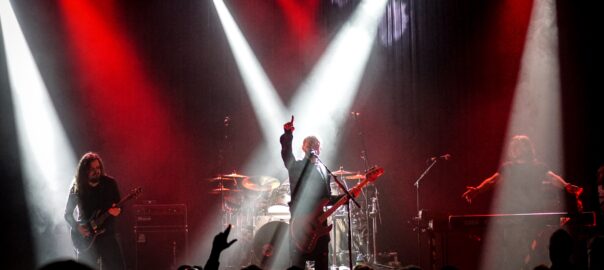
I went to the show with a whole bunch of other people, some local, some from abroad, I bought some merch, I had an actual camera and took some (pretty crappy—I had no idea what I was doing) pictures, and afterwards we found the back of the venue and waited, and…yes, they came out and for the first time I met and talked to Mariusz Duda, Michał Łapaj, and Piotr Grudziński (Kozieradzki did not make an appearance). I do not believe I will ever forget that night.
That was the beginning of an extraordinary journey. I saw Riverside 21 more times, and most of those gigs involved travel (something else I became a bit addicted to—thanks, Riverside!). They did their first exploratory tour of the US that very May, in fact, a handful of shows around 2013’s RoSFest, and I attended that and their show in Syracuse. That latter was the first time I sat and talked to Mariusz at length. Germany in 2014; Toronto and three US cities in 2015; my first trip to Warsaw to see them in 2017, as they returned to the stage after the shocking death of Piotr Grudziński. I fell in love with Poland and returned six more times (sometimes even to see Riverside). More North American tours, a weekend trip to Barcelona. I never tired of watching them live.
And most of the time, I met the guys, talked to them, hung out. My friendship with Mariusz grew and flourished. And not just the band: there are the connections with other fans, people from around the world I would never have otherwise gotten to know but for our shared love for Riverside, their music, and their shows.
Collecting their music and attending their shows was not the whole of it by any means. Shortly after I discovered the band I took over an abandoned Facebook Page called Mariusz Duda Street Team and started promoting Riverside—and Lunatic Soul—relentlessly. I’m sure I made a major pest of myself, but I didn’t care (still don’t). I became an admin of the Riverside Facebook Group. I also started a blog (which you are reading!) and began to review the band’s music (among many other things, of course. It wasn’t a “Riverside” blog by any means). I was somewhat startled (but enormously gratified) to discover that Mariusz Duda read those reviews. Eventually, I was sent album files in advance of the release dates so that I could get a jump on the reviews, and Mariusz would link to them from his social media pages.
Then…something extraordinary. In late 2020, I received a suggestion that took me aback. “You know what I think?” Mariusz said to me. “You should write a book. About Riv, LS. I can help you.”
And so, the biography has taken shape (slowly, but it progresses), and the fact that I am writing it is a thing that, at some level, my brain still has difficulty processing. It certainly wasn’t anything I had set out to do; I had no aim at all with the blog and the social media pages beyond telling anyone who would listen about this extraordinary music that somehow spoke directly to my heart.
The end of Riverside means the end of one of the most important eras of my life. I won’t pretend I was surprised: one of the aspects of writing a biography, especially one that is ongoing, is knowing what is happening behind the scenes. I saw the end coming, and I’ve had a long time to prepare. Nevertheless, for more than a decade, knowing I would see this band again was one of the highlights of my life. I think that is the hardest part to imagine: to realize there will be no more announcements: “Guys, we’re coming back to you…”
I will miss them terribly. However, I am unspeakably grateful for the time with them that I did have, and the friendships that have resulted. I would not change any of that for the world.
Part II: Legacy
“No man ever steps in the same river twice,” the ancient saying goes, “for it is not the same river and he is not the same man.” This is an aphorism that Riverside and Mariusz Duda have taken very much to heart, and a metaphor, introduced on their first album in 2003, that has flowed through much of the rest of their subsequent discography. The first three albums were united by a common theme and heavy progressive sound, but once the Reality Dream trilogy was complete, Mariusz and the guys were determined to change things up with every subsequent album. The band evolved, the sound evolved, and their river flowed onward. The same Riverside, but changed, marked by time and circumstance, and Mariusz never hesitated to work that into the words and music. The life of Riverside can be traced through their albums. Now that things are over (I’ll address in Part III the notion that the band can carry on), what have they left behind?
“Hey AI,” I asked (Claude, ChatGPT, Google…): “What are the most important modern prog bands?” The answers were all the same (which they would be, but that’s a different discussion): Dream Theater and Tool and Opeth and Porcupine Tree and…Riverside, a band who, the bots noted, are unique for their atmospheric and emotional power. It might be a strange way of assessing relevance, but this is where we are, and they have made the grade.
There is a joke in Poland, except maybe it isn’t all that funny, that Riverside are more famous outside their own country than in it; nevertheless, their Polish fans are enormously proud of them, as they should be. However, there is no denying that they have really made their mark internationally: they are beloved all over the world as a band that created music with huge emotional resonance, that was never afraid to push boundaries and step outside of their own expectations and those of the fan-base. Not every album is popular with every fan, but every album is somebody’s favourite. It’s fair to say that we grew accustomed to expecting the unexpected with Riverside.
Riverside didn’t break through suddenly; this was a band that grew its fanbase incrementally over years, based on hard work and dedication, gig by gig, album by album, tour by tour. People bought a record, loved it, and told others. They went to shows, and then went to more shows with their friends. Tours grew longer, and extended farther across the world. North and South America loved them: some of their fiercest audiences were in Mexico and Montreal. In later years when Mariusz Duda asked how many people were seeing them for the first time, often half the audience would raise their hands.
I’ve seen the reminiscences in the Riverside Facebook fan group, as people recount their memories with the band, and one thing they all have in common is just how immersive the whole experience was. The music of course—that is what brought us here in the first place, the unmistakable, unique sound of this band, dropped into the “prog” genre but not bound by any of the assumptions, expectations, demands, or stereotypes the style seems to engender. They were not technical wizards or virtuosos (with the possible exception of Michał Łapaj) in a context that celebrates virtuosity; there was no posturing; the music could be complex but no more than it needed to be, and simple when that was necessary—everything they did was at the service of the music and its emotional power. In fact, it is fair to say that Mariusz Duda hated prog stereotypes, and tried to put as much distance between the sound of the band and those as possible. They stayed true to their own vision.
It went beyond the music, though, beyond going to a gig and watching the guys on stage, participating, singing along, immersing oneself in the live experience. The shared energy and interplay between fans and band during a show was a manifestation of something else Riverside was noted for, to an uncommon degree—their accessibility. It was a rare gig that did not see them eventually emerge from the back rooms and make time for their fans. They remembered—and appreciated—the people who showed up often. They were happy to chat, to sign things, and to make themselves available. Maybe there were difficulties with each other, but that did not seep into their relationship with us.
We call ourselves The Riverside Family, something the fans of many bands do, but with Riverside it really felt like one. The band members were like friends; other fans became familiar because you met them at show after show. Riverside truly loved and were grateful to their followers, and that love and loyalty were returned to them many times over. I am genuinely sorry for all the fans, especially new ones, who post excitedly in the groups about this new discovery, who have only seen the band once or twice or not at all—and now never will.
Riverside’s great legacy is how beloved they became, how proud they made their home country and Polish fans, and how they delivered that love and pride around the world. Not just with the music, as creative and visionary as it was, but also because they were simply one of the most authentically honest outfits I have ever encountered, always available to fans, always willing to chat, to sign albums, to respond, to engage. They were the whole package. We will miss their music, the anticipation of a new album and a new tour…but most of all we will miss them, our guys, the heads of the Riverside Family.
Part III: What the Hell Just Happened?
I have a couple of aims for this section. First, to give a summary of that crazy week at the end of April, and second, to have a look at some of the fan reactions and fallout and to discuss as far as possible why the band is finished. Because, despite what many people seem to think, Riverside ain’t coming back in any recognizable form. I say “as far as possible” simply because, even though I know much, I cannot say much. Not yet, and not here.
First, an Overview.
On April 23, Mariusz Duda announced his departure from Riverside, the band he had guided for 25 years, basically citing irreconcilable differences with one of the members (not named). It was a very personal statement, and said what was necessary while alluding to long-standing toxic relationships and the necessity of being true to oneself, and referring fans to the lyrics of the Lunatic Soul album The World Under Unsun. Of course, the fanbase and beyond erupted in sorrow, shock, and rampant speculation <insert eye-roll, or maybe facepalm>, as it would; overall however, the responses and support for him were accepting and positive, if sad.
His words were immediately followed by a terse and frankly unnecessary comment from drummer Piotr Kozieradzki*, to wit: “How can a person who didn’t start a band disband it? That’s interesting.” (Jak człowiek, który nie zakładał zespołu może go rozwiązać? A to ciekawe). If nothing else, it certainly made clear which member Mariusz was referring to. As far as I know, he has made no other statement on the matter. Sadly, as a result of this comment the fault-lines within the band and among their friends fractured and things started to get ugly. The unfriendings began.
Mariusz’s statement was followed, a few days later, by one from keyboard player Michał Łapaj. In it he expressed his own shock and dismay at the announcement, and the entirely reasonable wish for the difficulties to have been sorted out and this result avoided. However, he also made a point of distancing himself from the conflict, which seemed a bit odd, because of all the people in the band he was the least likely to have been considered to be involved in any such issues. He did not specifically elucidate whether he was staying or going.
Finally, guitarist Maciej Meller posted his own lengthy and considered statement, one of maturity and careful honesty, in which important details were clarified. He explained that problems had existed for a while, and the hiatus of 2025 was imposed to try to work them out. Alas, the efforts to reconcile had failed, so a proposal was made—and a statement written—to present at least a unified front to the world about the end of the band, but even then no agreement could be reached. Mariusz took the only step that was open to him. Maciej made it quite clear that he was also leaving the band.
Up to this point, everything I have summarized (except possibly details in the third paragraph) is public knowledge and should not come as a surprise to anyone following the developments.
*to clarify: Kozieradzki owns the name “Riverside” and so only he can (or agree to) officially disband the outfit. Therefore, in the absence of any agreement or action from the legal owner of the name, the other guys can only quit.
At this point, it is unclear what the “official” fate of Riverside is, or if any such announcement is forthcoming. With the unequivocal departure of two members including the group’s driving force, it is hard to imagine what form a band by that name could possibly take. I will state this up front—it will not—could not possibly, resemble in any form the band of the past 25 years. Not even close. “Riverside” at the moment is just a name on paper.
I have mentioned in Part I above (and on occasion before this) that I have been writing Mariusz Duda’s biography for a few years now. Lately it has been delayed somewhat because the decision has been taken to end it at this point in his career; a lot has happened behind the scenes in the past year or so, and it just seems logical to try to incorporate as much of it as possible into the last couple of chapters. That means it’s difficult for me to step back and view Mariusz’s statement as an outsider because I have been a party to its origins and context for a long time now. Speculation is not surprising, and of course people are going to “read” it in different ways depending on their own view of the band. I was glad to see overall positivity and acceptance, but there were certainly some critical reactions.
I’ll tell you what I did not expect though: how it divided the fans and the band’s friends along partisan lines. Hell, I didn’t even realize there were going to be lines, at least to the degree they manifested, but perhaps that was my own naiveté playing out. I’ve been caught up in the schisms myself, which I find rather sad because while I might be necessarily connected to Mariusz Duda, I considered myself a friend to everyone; it was never my intention to take sides.
So, can Riverside continue?
It depends on what you mean by “Riverside”, and “continue”.
I had (wrongly, it seems) assumed that many fans understood at least on some level how the band functioned. So I was rather surprised at the number of comments along the lines of “Just replace Mariusz and carry on.” “Get a new bassist, maybe a vocalist.” “Lots of bands have survived the loss of a member or two.”
On the other side, I saw a few comments such as “Riverside is finished; the guys just played what Mariusz told them to.”
Uh, no. It’s not like either of those situations; the truth is rather more complex and nuanced (as truth often is). It does suggest, however, how successful the band’s PR has been over the decades: the collective “Music by Riverside” in the album credits, at least up to Shrine of New Generation Slaves (after that, Mariusz decided that album credits would more accurately reflect member contributions, and he always insisted on “Lyrics by Mariusz Duda”). The public was meant to see a band that functioned as a unity, a cheerful collective, and while this was closer to (but not quite) the reality in the early years, over time what was promoted (in credits, interviews, videos) began to diverge from the truth.
What Mariusz brought to Riverside—right from the very beginning—was the overall concept and vision for each album (and beyond–i.e., the trilogies). He had the structure of the album, and the musical themes and key ideas of the songs in his head before anyone stepped into the recording space, and he possessed an almost uncanny ability to encourage and draw out crucial ideas from the other guys. Łapaj and Grudziński contributed important material to the albums, especially in the first decade, but it was Mariusz who recognized the significance of it, and saw how and where these ideas would fit. He wrote much of the music himself, of course, and directed, curated, and assembled the rest according to what he envisaged for the album. Indeed, it is Kozieradzki’s own recollections in the original biography of what Mariusz brought to the band that makes his statement above so ironic: maybe Mariusz was not a founding member, but Riverside became the band it is when he joined.
As noted, “Riverside” is a legal entity owned by Piotr Kozieradzki, so I imagine that technically he can hire replacements for Mariusz and Maciej (it is still unclear what Michał’s official status is) and carry on under that name.
But…is it likely that such an outfit could bear any sort of resemblance to Riverside as we know it, without the guiding vision of Mariusz Duda (even if we leave aside for the moment the fact that he wrote upward of 60% (and more in later years) of the music)? It is not simply a matter of getting a new bass player and/or vocalist and/or lyricist. The entire creative core of the band—what made Riverside sound like Riverside—would somehow have to be replaced. Now, I suppose it is not impossible that Kozieradzki could find someone (he’s been around the business for a long, long time), but would it be Riverside in any meaningful way? I think the answer is obvious.
Your experience discovering Riverside echoes very much my experience with Porcupine Tree. And it was thanks to PT, and the people on their forum, that I found some other bands that “I might like”. One was Riverside and turned out to be one of my faves of the bunch that I discovered. I am sad that I just could see them 8 times. I didn’t go abroad to see them, because they usually came to Spain to play. I am still mad at myself that I missed them at the Be Prog Festival (and I had a ticket) and then in the following Spanish gigs (because I was abroad those days). Those were the last gigs in Spain with Gru. But who could have known that…
I was very glad that Maciej helped to bring back the band and I was happy to make it to a few gigs more. Actually I saw them more times with Maciej than with Gru. In any case, I am so happy that I decided to see them in October 2011 when they came to Barcelona. I didn’t travel for many bands at that time, but I made the effort and it was so worth! That made me love and respect the guys even more. I also regret not having seen them in Poland ever. I tried a couple of times, but logistics or inconvenient dates made it impossible. I will keep the memories of those 8 fab concerts and the friends I made (and met! 😉 ) thanks to this amazing music.
This article is important and it is a good summary of the situation. I didn’t see the break up coming, or the tensions. I can’t see Riverside going on either. What it is left it can’t be Riverside anymore. Thanks Deb, for the article, and thanks to the guys, for all the music, past and future.
The band I loved so much I moved to Poland.(Well, not the only reason!) I was always surprised how few people in Poland-including my partner-hadn’t heard, or heard of “Reeversyde”. It was quite refreshing to actually hear “Friend or Foe” on RMF FM. I’ll always have memories of discussing Fish with them at an acoustic promotional gig at Empik in Gdansk when “Wasteland” was released, and seeing them, and Michał’s first solo gig at the Northern Arts Festival. (Along with Michał “jamming” with Tangerine Dream.)